

| M108 (& Owl Nebula) | ||
| Ursa Major Messier 108 (NGC3556) and Messier 97 (NGC3587) in the same field of view |
||
Messier 108 (also known as NGC 3556, nicknamed the Surfboard Galaxy) is a barred spiral galaxy about 46 million light-years away from Earth in the northern constellation Ursa Major. It was discovered by Pierre Méchain in 1781 or 1782. From the Earth, this galaxy is seen almost edge-on. This galaxy is an isolated member of the Ursa Major Cloud of galaxies in the local supercluster. It has a morphological classification of type SBbc in the de Vaucouleurs system, which means it is a barred spiral galaxy with somewhat loosely wound arms. The maximum angular size of the galaxy in the optical band is 11′.1 × 4′.6, and it is inclined 75° to the line of sight. This galaxy has an estimated mass of 125 billion solar masses (M☉) and bears about 290 ± 80 globular clusters. Examination of the distribution of neutral hydrogen in this galaxy shows discrete shells of expanding gas extending for several kiloparsecs, known as H1 supershells. These may be driven by currents of dark matter, dust and gas contributing to large star formation, having caused supernovae explosions. Alternatively they may result from an infall from the intergalactic medium or arise from radio jets. Observations with the Chandra X-ray Observatory have identified 83 X-ray sources, including a source at the nucleus. The brightest of these is consistent with an intermediate-mass black hole accreting matter. The galaxy is also emitting a diffuse soft X-ray radiation within 2.6 arcminutes of the optical galaxy. The spectrum of the source at the core is consistent with an active galactic nucleus, but an examination with the Spitzer Space Telescope showed no indication of activity. The supermassive black hole at the core has an estimated mass of 24 million solar masses (M☉). Four supernovae have been observed in M108. Description source: Wikipedia The Owl Nebula (also known as Messier 97, M97 or NGC 3587) is a planetary nebula approximately 2,030 light years away in the constellation Ursa Major. Estimated to be about 8,000 years old, it is approximately circular in cross-section with a faint internal structure. It was formed from the outflow of material from the stellar wind of the central star as it evolved along the asymptotic giant branch. The nebula is arranged in three concentric shells, with the outermost shell being about 20–30% larger than the inner shell. The owl-like appearance of the nebula is the result of an inner shell that is not circularly symmetric, but instead forms a barrel-like structure aligned at an angle of 45° to the line of sight. The nebula holds about 0.13 solar masses (M☉) of matter, including hydrogen, helium, nitrogen, oxygen, and sulfur; all with a density of less than 100 particles per cubic centimeter. Its outer radius is around 0.91 ly (0.28 pc) and it is expanding with velocities in the range of 27–39 km/s into the surrounding interstellar medium. The 14th magnitude central star has passed the turning point in its evolution and is condensing to form a white dwarf. It has 55–60% of solar mass, is 41 to 148 times solar luminosity (L☉), and has an effective temperature of 123,000 K. The star has been successfully resolved by the Spitzer Space Telescope as a point source that does not show the infrared excess characteristic of a circumstellar disk. History The Owl Nebula was discovered by French astronomer Pierre Méchain on February 16, 1781. Pierre Méchain was Charles Messier's observing colleague, and the nebula was observed by Messier himself a few weeks following the initial sighting. Thus, the object was named Messier 97, and included in his catalog on March 24, 1781. Of the object, he noted:
In 1844, Admiral William H. Smyth classified the object as a planetary nebula. When William Parsons, 3rd Earl of Rosse, observed the nebula in Ireland in 1848, his hand-drawn illustration resembled an owl's head. In his notes, the object was described as "Two stars considerably apart in the central region, dark penumbra round each spiral arrangement, with stars as apparent centres of attraction. Stars sparkling in it; resolvable." It has been known as the Owl Nebula ever since. More recent developments in the late 1900s include the discovery of a giant red halo of wind extended around its inner shells, and the mapping of the nebula's structure. Observing Although the Owl Nebula can not be seen with the naked eye, a faint image of it can be observed under remarkably good conditions with a small telescope or 20×80 binoculars. To make out the nebula's more distinctive owl like eye features, a telescope with an aperture 10" or better is required. To locate the nebula in the night sky, look to the southwest corner of the Big Dipper's bowl, marked by the star Beta Ursae Majoris. From there, M97 lies just over 2.5 degrees in the southeast direction towards the star positioned opposite Beta Ursae Majoris in the other bottom corner of the Big Dippers Bowl, Gamma Ursae Majoris; which marks the constellations southwest corner. M97, together with Alpha Ursae Majoris, point the way to Polaris. Description source: Wikipedia  Messier 108 De acuerdo con el manuscrito preliminar de Charles Messier y versión no publicada de su catálogo, M108, al igual que M109, fue descubierta por Pierre Méchain poco después de M97 (la cual se encontró el 16 de febrero de 1781): Méchain descubrió M108 tres días más tarde de M97 el 19 de febrero de 1781, y M109 el 12 de marzo de 1781. Ambos objetos parece que fueron también observados por Charles Messier cuando media la posición de M97 (14 de marzo de 1781), pero aparentemente no encontró el momento propicio para obtener la posición de esos objetos en aquel momento. Messier listó este objeto, M108, bajo el número '98' en su manuscrito, versión preliminar de su catálogo, sin asignarle una posición. De acuerdo con Owen Gingerich, midió una posición precisa un tiempo más tarde la cual fue añadida manualmente en su copia personal del catálogo. Ambos objetos, M108 y M109 también son mencionados en la carta de Pierre Méchain del 6 de mayo de 1783, la cual apoya la sospecha de que probablemente quería añadirlas en una edición posterior del catálogo de Messier. El objeto M108 fue añadido finalmente al catálogo de Messier por Owen Gingerich en 1953. Como el descubrimiento de M108 no había sido publicado, William Herschel redescubrió independientemente este objeto el 17 de abril de 1789, y lo catalogó como H V.46. El borde cercano de la galaxia M108 parece no tener ninguna protuberancia ni ningún núcleo pronunciado, es solo un disco moteado rico en detalles con un gran oscurecimiento a lo largo del eje mayor, con unas pocas regiones H II y cúmulos de estrellas jóvenes expuestos contra el fondo caótico -- en una palabra: 'Muy Sucio'. Hay pequeñas evidencias de un patrón espiral bien definido es esta galaxia de tipo Sc, la cual se aleja a 772 km/s. De acuerdo con Brent Tully, está a unos 45 millones de años luz de distancia, y es miembro de la nube de la Osa Mayor, una disperso racimo de galaxias. Tully clasifica esta galaxia como SBcd, es decir Sc muy tardía y barrada; el presente autor no puede encontrar evidencias sobre esto a partir de las imágenes conocidas. Es también una galaxia de brote estelar La supernova de tipo II 1969B tuvo lugar en M108 y alcanzó la magnitud 13,9 el 23 de enero de 1969. M 108 es bastante sencilla para los aficionados, más sencillo de lo que implican los valores publicados de su brillo (excepción: Don Machholz' estima una mag 9,4). La descripción más acertada es quizá la de John Mallas: 'una belleza blanca plateada, con forma de plato y muy bien definida' con algo de brillo e irregularidades en la región central, rodeada por 'ligeros y oscuros nódulos'. Es un objeto muy alargado con una dimensión angular de 8x1'. ¡Es en realidad sorprendente la cantidad de detalles que pueden verse en esta galaxia con un pequeño instrumento! Las fotografías a color muestran un aspecto incluso más visible de lo que debería, la cual a veces aparece en fotografías de campo abierto del espacio profundo junto a la nebulosa Owl M97, la cual se encuentra a solo 48' al Sureste. Nota: texto reproducido con la autorización del autor AstroSeti Fuente: Wikipedia La nebulosa del Búho (también conocida como Messier 97 o NGC 3587) es una nebulosa planetaria ubicada en la constelación de la Osa Mayor. Fue descubierta por Pierre Méchain en 1781. El nombre de Nebulosa del Búho fue acuñado por Lord Rosse, quien por vez primera lo utilizó en 1848. En 1866, William Huggins reconoció su naturaleza de nebulosa gaseosa a partir de la observación de su espectro. Se encuentra a una incierta distancia de 2600 años luz de la Tierra. M97 está considerada como una de las nebulosas planetarias más complejas. Su apariencia ha sido interpretada como una cubierta cilíndrica tórica vista oblicuamente, de forma que los extremos del cilindro se asocian a zonas pobres en material expulsado, correspondiendo a los ojos del búho. Esta cubierta se halla envuelta por una nebulosa más tenue y menos ionizada. La estrella central, de magnitud 16, tiene una masa aproximada de 0,7 masas solares, mientras que la masa de la propia nebulosa se estima en 0,15 masas solares. La nebulosa se formó hace unos 6000 años. Observación Entre los objetos del catálogo Messier, la nebulosa de la Lechuza (M97), es uno de los más difíciles de observar. No deben aparecer dificultades al intentar localizarlo con un telescopio de 75 mm, con pocos aumentos y un cielo despejado, limpio y raso. Para encontrar la nebulosa, hay que buscar justo bajo la parte trasera de la caja del Carro de la Osa Mayor. Con más exactitud, se halla a unos 2 grados al sudeste de Merak, la estrella que marca la rueda trasera del carro. Así aparecería como un óvalo grande y sin detalles internos. Con mayores aumentos empiezan a apreciarse algunos rasgos, aunque se requiere de un telescopio de 150 mm a 200 mm para vislumbrar los ojos oscuros de la lechuza. El filtro nebular ayuda a realzar el contraste entre el objeto y el fondo, pero si no se dispone del mismo, puede emplearse la técnica de la visión lateral o evitada, que consiste en apartar la mirada de la nebulosa ligeramente para que la luz de la misma estimule las células periféricas del ojo, más sensibles. Así la frontera entre nebulosa y entorno se torna más manifiesta de repente. Se puede detectar con solo tres prismáticos: 10x50, 15x70 y 20x50, ambos bajo cielos muy estrellados, sin polución y rasos. Con estos prismáticos, se puede observar como una estrella difusa, como un punto "estrelliforme" un tanto borroso. 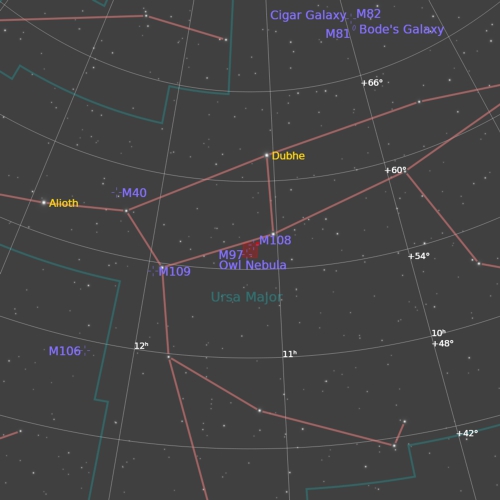 |
||
| Technical details: | ||
Location: |
Valdemorillo - Spain | |
Date: |
18/04/2026 (dd/mm/yyyy) | |
Conditions: |
Average | |
Temperature: |
ºC | |
Humidity: |
||
Telescope: |
TS Imaging Star 130 f/5 | |
Reducer/corrector: |
No reducer | |
Filter: |
No filter | |
Mount: |
Orion Atlas EQG | |
Camera: |
ZWO ASI533MC | |
Exposure: |
21x180s @ T-10º | |
Guiding tube: |
50/350mm guider | |
Guiding camera: |
Meade DSI Pro | |
Guiding software: |
PHD2 Guiding | |
Procesing: |
PixInsight | |
Notes: |
||
All Contents Copyright by Jaime Fernández and Copyright of their respectives owners. Text mainly extracted from Wikipedia.
All Jaime Fernandez propietary contents freely available for non-profit purposes,
otherwise I beg you for a fair contribution to NGO Medicos Sin Fronteras proportional to the profit obtained.
Este sitio web usa cookies para su funcionamiento. No utiliza cookies publicitarias ni de personalización.
Al navegar por esta web aceptas el uso de estas cookies y que tus datos de navegación sean anónimamente recopilados para conteo estadístico y control de acceso
(IP origen, fecha y hora, página visitada y términos de búsqueda usados).