| |
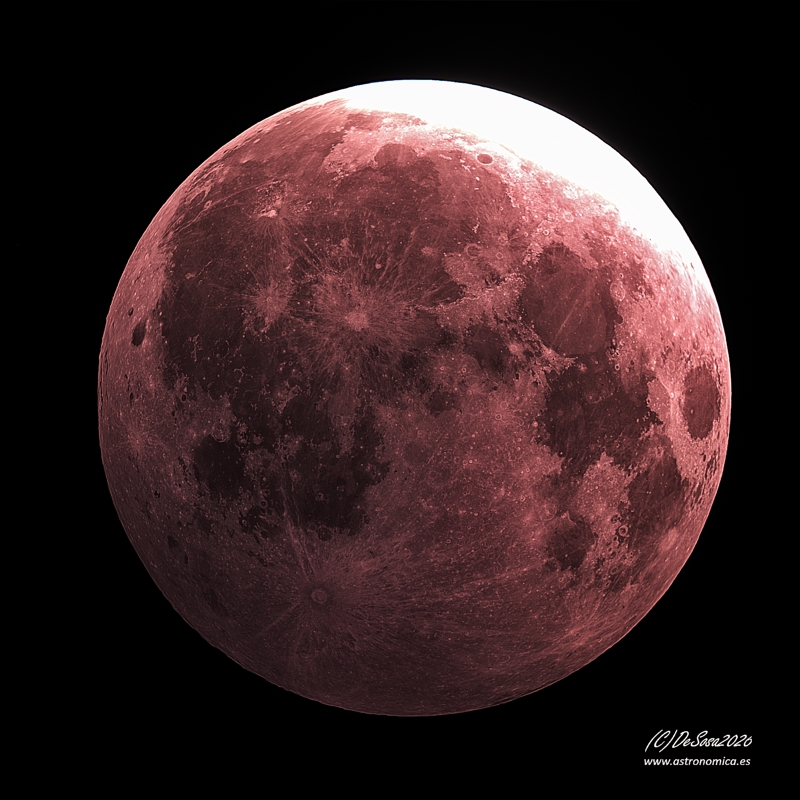
| Deep partial lunar eclipse, 15.44 days 100.0%
|
|
Moon
On August 28, 2026 (the night of the 27th in some time zones), the Moon entered Earth's shadow, creating a profound partial eclipse. |
|
| |
At the moment of maximum obscuration, at 4:13 AM UTC, 96.3% of the lunar disk was within Earth's umbra, the central part of the shadow where the Sun is completely blocked by the Earth. This portion of the eclipse was visible in the Americas (except Alaska and northwestern Canada), Western Europe, and West Africa.
The penumbra is the part of Earth's shadow where the Sun is partially covered by the Earth. The effect of the penumbra on the Moon's appearance is subtle. But once the partial phase began, at 2:34 UTC, the dramatic effect of the umbra was readily visible as it gradually reduced the disk of the full Moon. Less than an hour later, the portion of the Moon still illuminated by the sun was small enough for observers' eyes to adjust to the darkness and perceive the coppery color of the part of the Moon within the umbra.
This eclipse belongs to Saros series 138. Eclipses in a Saros series are separated by 18 years, 11 days, and 8 hours. The previous eclipse in this Saros series occurred on August 16, 2008, and the next will take place on September 7, 2044.
El 28 de agosto de 2026 (la noche del 27 en algunas zonas horarias), la Luna entró en la sombra de la Tierra, creando un profundo eclipse parcial. En el momento de máxima ocultación, a las 4:13 AM hora universal, el 96,3 % del disco lunar se encontró dentro de la umbra terrestre, la parte central de la sombra donde el Sol queda completamente bloqueado por la Tierra. Esta parte del eclipse fue visible en América (excepto Alaska y el noroeste de Canadá), Europa occidental y África occidental.
La penumbra es la parte de la sombra terrestre donde el Sol está parcialmente cubierto por la Tierra. El efecto de la penumbra en la apariencia de la Luna es sutil. Pero una vez que comenzó la fase parcial, a las 2:34 UTC, el efecto dramático de la umbra fue fácilmente visible a medida que iba reduciendo progresivamente el disco de la Luna llena. Menos de una hora después, la parte de la Luna que aún permanecía iluminada por el sol fue lo suficientemente pequeña como para que los ojos de los observadores se adaptaran a la oscuridad y percibieran el color cobrizo de la parte de la Luna dentro de la umbra.
Este eclipse pertenece a la serie Saros 138. Los eclipses de una serie Saros están separados por 18 años, 11 días y 8 horas. El eclipse anterior de esta serie Saros ocurrió el 16 de agosto de 2008, y el próximo tendrá lugar el 7 de septiembre de 2044.
|
|
| |
| Technical details: |
|
Location: |
Valdemorillo - Spain |
Date: |
28/08/2026 (dd/mm/yyyy) |
Conditions: |
Very good |
Temperature: |
9.4ºC |
Humidity: |
90 |
|
|
Telescope: |
TS Imaging Star 130 f/5
|
Reducer/corrector: |
No reducer
|
Filter: |
No filter
|
Mount: |
Orion Atlas EQG
|
Camera: |
ZWO ASI533MC
|
Exposure: |
2000 frames @ 17fps T=-10ºC |
Guiding tube: |
No guiding
|
Guiding camera: |
No guide camera
|
Guiding software: |
No guide software
|
|
|
Procesing: |
|
|
Notes: |
Start: 4:12:23h UTC
End: 4:14:20h UTC |
|
| |
|
|
|
|


