

|
|
Saturn satellites - March/2009 Saturn Representation of Saturn satellites based on real picture data. Taken on 19/march/2009 at 23:35h TU |
||
| In this picture five of the satellites have been highlighted via processing and labeled from the original picture for didactic purposes.
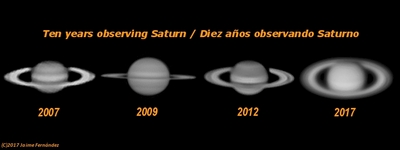
History: The rings were first observed by Galileo Galilei in 1610 with his telescope, but he was unable to identify them as such. He wrote to the Duke of Tuscany that "The planet Saturn is not alone, but is composed of three, which almost touch one another and never move nor change with respect to one another. They are arranged in a line parallel to the zodiac, and the middle one (Saturn itself) is about three times the size of the lateral ones [the edges of the rings]." He also described Saturn as having "ears." In 1612 the plane of the rings was oriented directly at the Earth and the rings appeared to vanish. Mystified, Galileo wondered, "Has Saturn swallowed his children?", referring to the myth of the god Saturn eating his own children to prevent them from overthrowing him. Then, in 1613, they reappeared again, further confusing Galileo. In 1655, Christiaan Huygens became the first person to suggest that Saturn was surrounded by a ring. Using a telescope that was far superior to those available to Galileo, Huygens observed Saturn and wrote that "It [Saturn] is surrounded by a thin, flat, ring, nowhere touching, inclined to the ecliptic." In 1675, Giovanni Domenico Cassini determined that Saturn's ring was composed of multiple smaller rings with gaps between them; the largest of these gaps was later named the Cassini Division. This division in itself is a 4,800 km wide region between the A Ring and B Ring. In 1859, James Clerk Maxwell demonstrated that the rings could not be solid or they would become unstable and break apart. He proposed that the rings must be composed of numerous small particles, all independently orbiting Saturn. Maxwell's theory was proven correct in 1895 through spectroscopic studies of the rings carried out by James Keeler of Lick Observatory. |
||
| Technical details: | ||
Location: |
Valdemorillo - Spain | |
Date: |
19/03/2009 (dd/mm/yyyy) | |
Conditions: |
Good | |
Temperature: |
10ºC | |
Humidity: |
low | |
Telescope: |
Meade SC8" f/10 | |
Reducer/corrector: |
No reducer | |
Filter: |
No filter | |
Mount: |
Vixen GPD2 Autostar Meade | |
Camera: |
Canon 350D no filter | |
Exposure: |
1677fr @5fps | |
Guiding tube: |
No guiding | |
Guiding camera: |
No guide camera | |
Guiding software: |
No guide software | |
Procesing: |
||
Notes: |
||

All Contents Copyright by Jaime Fernández and Copyright of their respectives owners. Text mainly extracted from Wikipedia.
All Jaime Fernandez propietary contents freely available for non-profit purposes,
otherwise I beg you for a fair contribution to NGO Medicos Sin Fronteras proportional to the profit obtained.