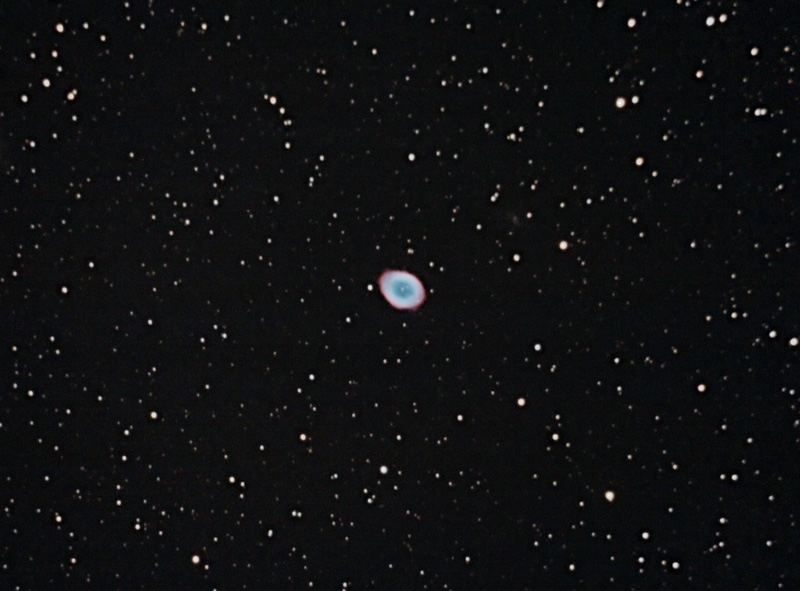
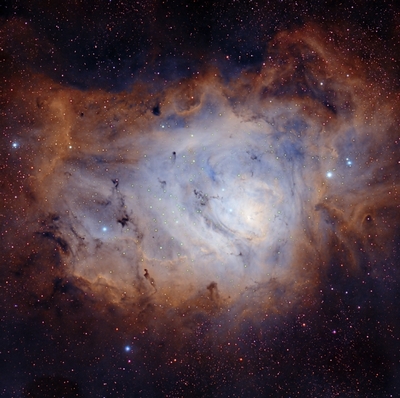
M57 - NGC6720 - Ring Nebula
Lyra
Discovered by Antoine Darquier de Pellepoix in 1779. In 1800, Count Friedrich von Hahn discovered a faint central star at the center of the nebula.
|
| |
The famous Ring Nebula M57 in Lyra is often regarded as the prototype of planetary nebulas. Recent research has confirmed that it is, most probably, actually a ring (torus) of bright light-emitting material surrounding its central star, and not a spherical (or ellipsoidal) shell. Deep observations also show an extended halo of material extending off to over 3.5 arc minutes, remainders of the star's earlier stellar winds.
The central star is a planet-sized white dwarf star, which shines at about 15th magnitude. It is the remainder of a sunlike star which has blown away its outer envelopes at the end of its evolution. Now over 100.000 K hot, it will soon start to cool down, shine as a white dwarf star for a while of several billions of years, and then eventually end as a cold Black Dwarf.
As for most planetary nebulae, the distance to the Ring Nebula M57 is not very well known, estimates range from 1.000 to 4.100 light years. It has an apparent diameter of 1 arc minute and its real diameter is about one light year. At magnitude 9.0 its high surface brightness makes it an easy object, even from the city and even with small telescopes.
|
|
| |
| Technical details: |
|
Location: |
Guadalix de la Sierra - Spain |
Date: |
22/06/2007 (dd/mm/yyyy) |
Conditions: |
Normal |
Temperature: |
9ºC |
Humidity: |
high |
|
|
Telescope: |
Meade SC8" f/10 |
Reducer/corrector: |
f/6.3 Meade |
Filter: |
No filter |
Mount: |
Vixen GPD2 Autostar Meade |
Camera: |
Canon 300D Schott filter |
Exposure: |
2x300 |
Guiding tube: |
Skylux 70/700 f/10 |
Guiding camera: |
Celestron NexImage |
Guiding software: |
K3CCDTools |
|
|
Procesing: |
No flats, no bias. Levels and curves, wavelets. |
|
Notes: |
Bad guiding data. |
|
|
|
|
|