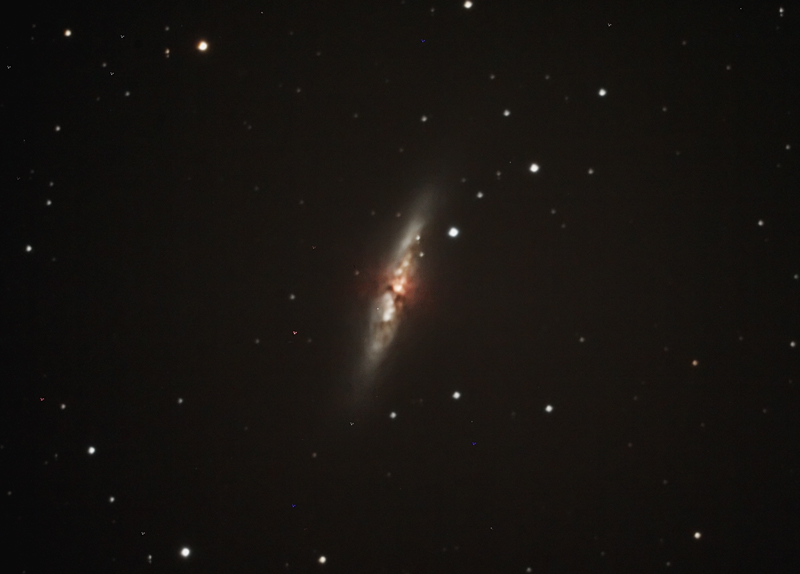
Forming a striking pair in small telescopes with nearby M81, M82 is being physically affected by its bigger neighbor. Tidal forces caused by gravity have deformed this galaxy, a process that started about 100 million years ago. This interaction has caused star formation to increase 10 fold compared to "normal" galaxies. Ignoring any difference in their respective distances from us, the centers of M81 and M82 are visually separated by about 130,000 light-years. The actual separation is 300+300−200 kly.
The Chandra X-ray Observatory detected fluctuating X-ray emissions from a location approximately 600 light-years away from the center of M82. Astronomers have postulated that this fluctuating emission comes from the first known intermediate-mass black hole, of roughly 200 to 5000 solar masses.
M82 was previously believed to be an irregular galaxy. However, in 2005, two symmetric spiral arms were discovered in the near-infrared (NIR) images of M82. The arms were detected by subtracting an axisymmetric exponential disk from the NIR images. These arms emanate from the ends of the NIR bar and can be followed for the length of 3 disc scales. Even though the arms were detected in the NIR images, they are bluer than the disk. Assuming that the northern part of M82 is nearer to us, which most literature assumes, the observed sense of rotation implies trailing arms. Due to M82's high disk surface brightness, nearly edge-on orientation with respect to us, and the presence of a complex network of dusty filaments in optical images, the arms were not previously detected.
|
|