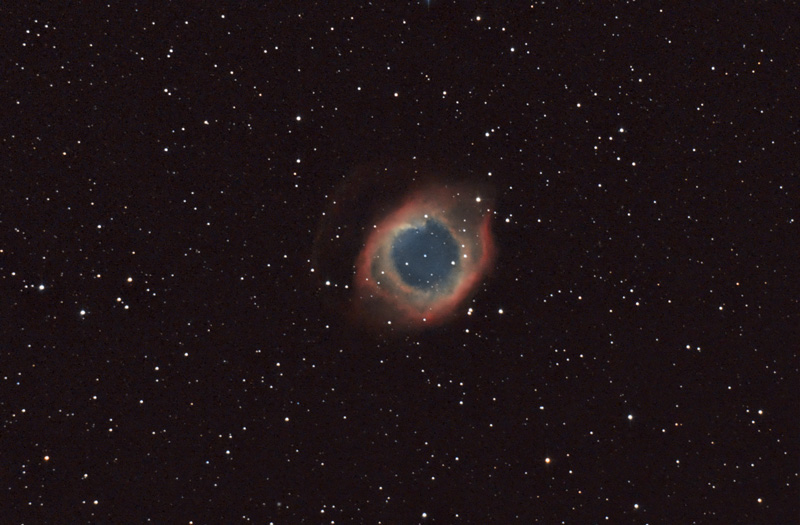
The Helix Nebula is an example of a planetary nebula, or 'planetary' formed at the end of a star's evolution. Gases from the star in the surrounding space appear, from our vantage point, as if we are looking down a helix structure. The remnant central stellar core, known as a planetary nebula nucleus, is destined to become a white dwarf star. The observed glow of the central star is so energetic that it causes the previously expelled gases to brightly fluoresce.
The Helix Nebula in the constellation of Aquarius lies about 700 light-years away, spanning about 0.8 parsec or 2.5 light-years. It was discovered by Karl Ludwig Harding, probably before 1824.
The Helix Nebula is thought to be shaped like a prolate spheroid with strong density concentrations toward the filled disk along the equatorial plane, whose major axis is inclined about 21° to 37° from our vantage point. The size of the inner disk is 8×19 arcmin in diameter (0.52 pc); the outer torus is 12×22 arcmin in diameter (0.77 pc); and the outer-most ring is about 25 arcmin in diameter (1.76 pc). We see the outer-most ring as flattened on one side due to its colliding with the ambient interstellar medium.
Expansion of the whole planetary nebula structure is estimated to have occurred in the last 6,560 years, and 12,100 years for the inner disk.
|
|