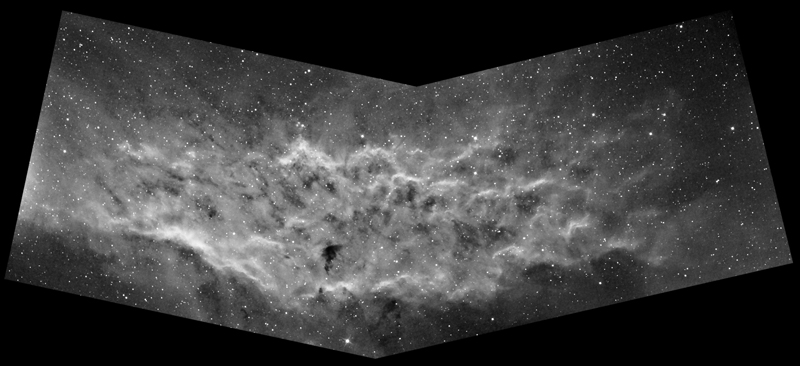
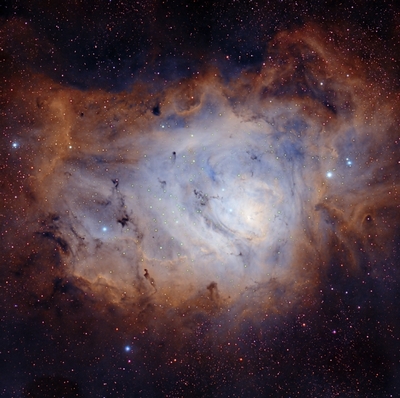
NGC1499 - California Nebula Ha Mosaic
Perseus
Faint emission nebula located in the constellation Perseus
|
| |
It is so named because it appears to resemble the outline of the US State of California on long exposure photographs. It is almost 2.5° long on the sky and, because of its very low surface brightness, it is extremely difficult to observe visually. It can be observed with a H-Beta filter (isolates the H-Beta line at 486 nm) in a rich-field telescope under dark skies. It lies at a distance of about 1,000 light years from Earth.
The California Nebula was discovered by E. E. Barnard in 1884.
This picture is a mosaic of two images. |
|
| |
| Technical details: |
|
Location: |
Valdemorillo - Spain |
Date: |
26/12/2009 (dd/mm/yyyy) |
Conditions: |
Normal |
Temperature: |
5ºC |
Humidity: |
56 |
|
|
Telescope: |
GSO Reflector 200mm f/4 |
Reducer/corrector: |
Baader MPCC |
Filter: |
Baader Ha 7nm 2" |
Mount: |
Vixen GPD2 Autostar Meade |
Camera: |
Canon 350D no filter |
Exposure: |
15x300s (LEFT) & 23x300s (RIGHT) @800iso |
Guiding tube: |
B&C 60/350 f7 |
Guiding camera: |
Meade DSI Pro |
Guiding software: |
PHD Guiding |
|
|
Procesing: |
Mosaic composed using PixInsight Core
Standard processing: levels, curves, HDRW. |
|
Notes: |
La unión de las dos tomas presenta defectos en su parte inferior que no he podido corregir. |
|
|
|
|