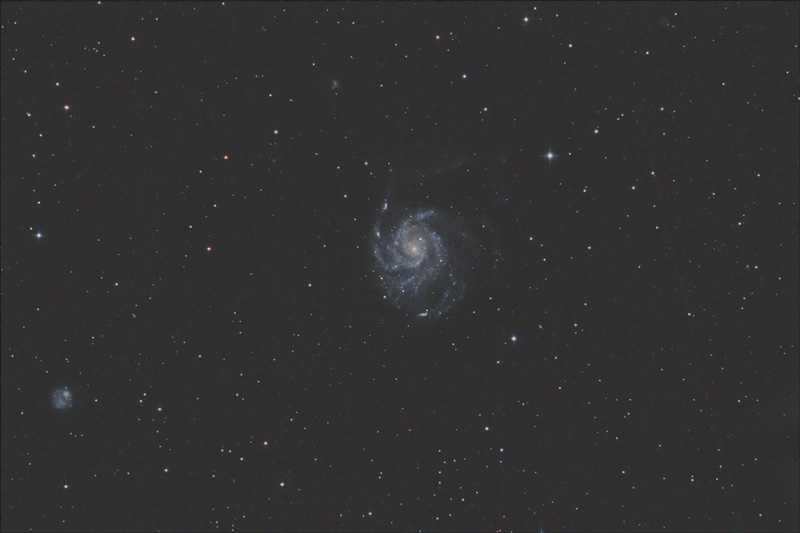
First discovered by Pierre Méchain on March 27, 1781, and communicated to Charles Messier who verified its position for inclusion in the Messier Catalogue as one of its final entries.
M101 is a relatively large galaxy compared to the Milky Way. With a diameter of 170,000 light-years it is nearly twice the size of the Milky Way. It has a disk mass on the order of 100 billion solar masses, along with a small bulge of about 3 billion solar masses.
Another remarkable property of this galaxy is its huge and extremely bright H II regions, of which a total of about 3,000 can be seen on photographs. H II regions usually accompany the enormous clouds of high density molecular hydrogen gas contracting under their own gravitational force where stars form. H II regions are ionized by large numbers of extremely bright and hot young stars.
On photographs M101 can be seen to be asymmetrical on one side. It is thought that in the recent past (speaking in galactic terms) M101 underwent a near collision with another galaxy and the associated gravitational tidal forces caused the asymmetry. In addition, this encounter also amplified the density waves in the spiral arms of M101. The amplification of these waves leads to the compression of the interstellar hydrogen gas, which then triggers strong star formation activity.
M101 has five prominent companion galaxies: NGC 5204, NGC 5474, NGC 5477, NGC 5585, and Holmberg IV.
NGC5474 is shown in the lower left corner of this picture, and NGC5477 is shown over M101 (upper quarter, slightly left from center). Many other faint galaxies are shown along this picture.
|
|