Hartley2 Comet & NGC281
Cassiopeia
Comet 103P/Hartley 2 passed near NGC281 past Oct2, 2010.
|
Awards & publications:

NASA Astronomy Picture of Day (APOD) 7/OCT/2010
Published in ESPACIO magazine, Feb.2011
|
|
| |
Comet Hartley 2 is a small periodic comet with an orbital period of 6.12 years. It was discovered by Malcolm Hartley in 1986 at the Schmidt Telescope Unit in Siding Spring, Australia. Its diameter is estimated to be 1.2 to 1.6 km.
 There is a planned flyby of Hartley 2 by the Deep Impact spacecraft with a closest approach of 700 kilometers on November 4, 2010. This is part of the EPOXI mission (image: NASA).
The comet will pass within 0.12 AU of the Earth on October 20, 2010, which is only eight days before coming to perihelion (closest approach to the Sun) on October 28, 2010. During this passage, the comet may be visible to the naked eye at apparent magnitude 5, in the constellation Auriga, near its open clusters.
The comet passed near the position of NGC 281 in Cassiopeia on October 2. On the night of October 7 at New Moon, the comet is expected to pass near the Double Cluster in the sky and near the open cluster NGC 1528 by October 14, both in Perseus, and by the end of the month the comet will be visible in the evening without interference from the Moon.
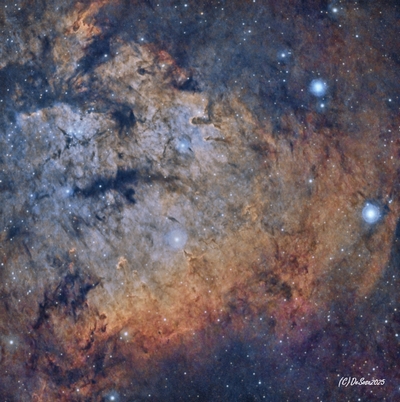
This picture shows the comet movement along 1 hour (the green line at the right) near NGC281.

Hartley 2 es un pequeño cometa con un periodo orbital de 6.12 años. Fue descubierto por Malcolm Hartley en 1986 desde el Schmidt Telescope Unit en Siding Spring, Australia. Se estima que su diámetro se encuentra entre 1.2 y 1.6 kilómetros.
La sontda Deep Impact tiene previsto un sobrevuelo del cometa a una distancia de 700 kilómetros el 4 de noviembre de 2010, como parte del proyecto EPOXI.
(imagen: NASA).
El cometa pasará a 0.12 unidades astronómicas de la Tierra el 20 de octubre de 2010, solo ocho días antes del perihelio (máxima aproximación al Sol) el 28 de octubre. Durante este paso el cometa será visible a simple vista con una magnitud aparente de 5 en la constelación de Auriga, próximo a su cluster abierto.
El cometa pasó cerca de la nebulosa NGC281 en Cassiopea en la noche del 1 al 2 de octubre. En la noche del 7 de octubre pasará cerca del Doble Cluster de Perseo, el día 14 cerca del cluster abierto NGC1528, y a finales del mes de octubre podrá verse al atardecer sin la interferencia de la Luna.
La imagen muestra el movimiento del cometa durante una hora (el trazo verde de la derecha) cerca de NGC281 (la nebulosa de la izquierda).
|
|
| |
| Technical details: |
|
Location: |
Valdemorillo - Spain |
Date: |
2/10/2010 (dd/mm/yyyy) |
Conditions: |
Good |
Temperature: |
15ºC |
Humidity: |
high |
|
|
Telescope: |
GSO Reflector 200mm f/4 |
Reducer/corrector: |
Baader MPCC |
Filter: |
IDAS LPS 2" |
Mount: |
Orion Atlas EQG |
Camera: |
Canon 350D no filter |
Exposure: |
12x300s@800iso |
Guiding tube: |
B&C 60/350 f7 |
Guiding camera: |
Meade DSI Pro |
Guiding software: |
PHD Guiding |
|
|
Procesing: |
Deep Sky Stacker and PixInsight standard processing. |
|
Notes: |
2:47-3:45 |
|
|
|
|
|