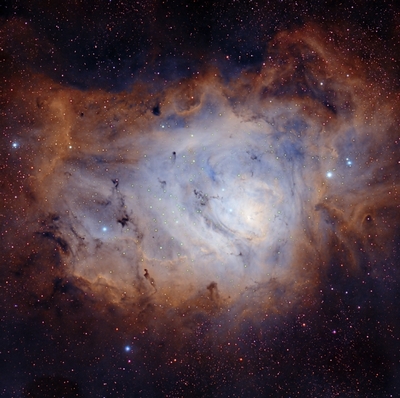
M31 - Andromeda Galaxy
Andromeda
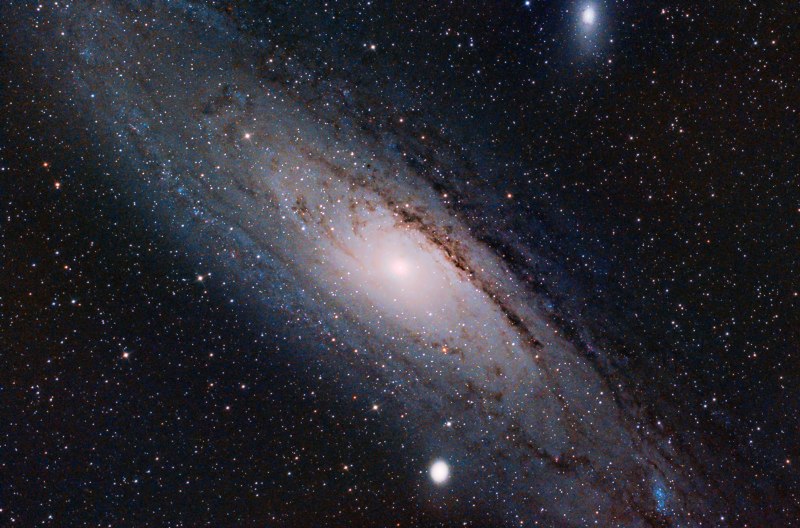
Spiral galaxy in the constellation Andromeda, also known as M31 and often referred to as the Great Andromeda Nebula
|
| |
The Andromeda Galaxy is located approximately 2.5 million light-years away. It is also known as NGC 224. Andromeda is the nearest spiral galaxy to the Milky Way, but not the closest galaxy overall. M31 is the largest galaxy of the Local Group, which consists of the Andromeda Galaxy, the Milky Way Galaxy, the Triangulum Galaxy, and about 30 other smaller galaxies.
The 2006 observations by the Spitzer Space Telescope revealed that M31 contains one trillion (1012) stars, more than the number of stars in our own galaxy, which is estimated to be c. 200-400 billion. The Andromeda Galaxy and the Milky Way are expected to collide in perhaps 4.5 billion years.
The Andromeda Galaxy has satellite galaxies, consisting of 14 known dwarf galaxies. The best known and most readily observed satellite galaxies are M32 and M110.
The galaxy is inclined an estimated 77° relative to the Earth.
At an apparent magnitude of 3.4, the Andromeda Galaxy is notable for being one of the brightest Messier objects, making it easily visible to the naked eye even when viewed from areas with moderate light pollution. Although it appears more than six times as wide as the full Moon when photographed through a larger telescope, only the brighter central region is visible to the naked eye or when viewed using a binoculars or a small telescope.
Nova M31 2009-08b (formerly 2009-08d):
(Mouse over image). It was confirmed the nova nature of the possible nova M31 2009-08d, discovered
by Rafael Ferrando on UT 2009 Aug 15.0950 (discovery image at http://www.pla-de-arguines.com/NOVA-M31D.jpg ). A single, filterless image of 20-s exposure time taken on UT 2009 Aug
18.1430 with the ACAM imager/spectrograph on the 4.2m William Herschel
Telescope (La Palma) reveals the object at coordinates RA=00h44m09.91s,
Dec=+41d48m51.0s (J2000), as reported. |
|
| |
| Technical details: |
|
Location: |
Valdemorillo - Spain |
Date: |
01/12/2010 (dd/mm/yyyy) |
Conditions: |
Average |
Temperature: |
10ºCºC |
Humidity: |
low |
|
|
Telescope: |
GSO Reflector 200mm f/4 |
Reducer/corrector: |
Baader MPCC |
Filter: |
IDAS LPS 2" |
Mount: |
Orion Atlas EQG |
Camera: |
Canon 350D no filter |
Exposure: |
21x60s + 19x180s + 7x300s @800iso |
Guiding tube: |
B&C 60/350 f7 |
Guiding camera: |
Celestron NexImage |
Guiding software: |
PHD Guiding |
|
|
Procesing: |
64bit HDR Composition from three calibrated and registrated images (60s, 180s and 300s), created with PixInsight 1.6 |
|
Notes: |
|
|
|
|
|
|