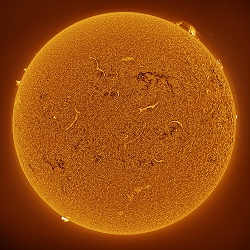
The Sun is the star at the center of the Solar System. It consists of hot plasma interwoven with magnetic fields.
A yellow dwarf, is the star at the center of the Solar System.
The Earth and other matter (including other planets, asteroids,
meteoroids, comets, and dust) orbit the Sun, which by itself accounts
for about 98.6% of the Solar System's mass. The mean distance of the Sun
from the Earth is approximately 149,600,000 kilometers and its light
travels this distance in 8 minutes and 19 seconds. Energy from the Sun,
in the form of sunlight, supports almost all life on Earth via
photosynthesis, and drives the Earth's climate and weather.
The
surface of the Sun consists of hydrogen (about 74% of its mass, or 92%
of its volume), helium (about 24% of mass, 7% of volume), and trace
quantities of other elements, including iron, nickel, oxygen, silicon,
sulfur, magnesium, carbon, neon, calcium, and chromium. The Sun has a
spectral class of G2V. G2 means that it has a surface temperature of
approximately 5,780 K (5,500 °C) giving it a white color that often,
because of atmospheric scattering, appears yellow when seen from the
surface of the Earth. When the Sun is low in the sky, even more light is
scattered so that the Sun appears orange or even red.
The V in
the spectral class indicates that the Sun, like most stars, is a main
sequence star. This means that it generates its energy by nuclear fusion
of hydrogen nuclei into helium. There are more than 100 million G2
class stars in our galaxy. Once regarded as a small and relatively
insignificant star, the Sun is now known to be brighter than 85% of the
stars in the galaxy, most of which are red dwarfs.
NEVER LOOK THROUGH A TELESCOPE OR BINOCULARS TO POINT AT THE SUN. Partial or total irreversible blindness result.
NUNCA
OBSERVES A TRAVÉS DE UN TELESCOPIO O BINOCULARES APUNTANDO AL SOL. El
resultado será una ceguera irreversible total o parcial.
|
|