
Vintage pictures
Imágenes antiguas
|
| |
|
|
|
|
|
|
Comet Picture Gallery |
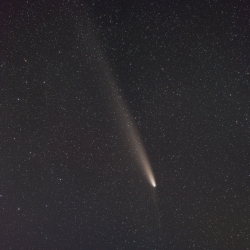
Small ice and dust body that orbits the Sun
When close enough to the Sun, exhibits a visible coma (or atmosphere) and/or a tail — both primarily from the effects of solar radiation upon the comet's nucleus. The nucleus itself measures a few kilometres or tens of kilometres across, and is composed mostly of rock, dust and ice.
Comets originate in the outer solar system; they are thrown inwards towards the Sun by gravitational perturbations from planets or nearby stars. They have a variety of different orbital periods, ranging from a few years, to 50 or 100 years, to thousands of years, while some are believed to pass through the inner Solar System only once before being thrown out into interstellar space.
Short-period comets are thought to originate in the Kuiper Belt, which lies beyond the orbit of Neptune. Long-period comets are believed to originate at a very much greater distance from the Sun, in a cloud (the Oort cloud) consisting of debris left over from the condensation of the solar nebula. Asteroids originate via a different process, but very old comets which have lost all their volatile materials may come to resemble asteroids.
There are a reported 3,354 known comets as of November 2007,[1] of which several hundred are short-period. This number is steadily increasing. However, this represents only a tiny fraction of the total comet population: the reservoir of comet-like bodies in the outer solar system may number one trillion.[2] The number of naked-eye comets averages to roughly one per year,[3] though many of these are faint and unspectacular.
The word "comet" came to the English language through Latin cometes from the Greek word komē, meaning "hair of the head"; Aristotle first used the derivation komētēs to depict comets as "stars with hair.". The astronomical symbol for comets (☄) accordingly consists of a disc with a hairlike tail.
|
|
| |
|
Asteroid |
2012DA14 flyby video
YEAR: 2013
|
| |
|
Cassiopeia |
Hartley2 Comet & NGC281
YEAR: 2010
|
| |
|
Comet |
C/2023 A3 (Tsuchinshan–ATLAS) comet
YEAR: 2024
|
M71 & C/2009 P1 Garradd + object trail
YEAR: 2011
|
M71 & comet C/2009P1 Garradd animation
YEAR: 2011
|
17P Holmes Comet Outburst
YEAR: 2007
|
| |
|